
 01727 800372

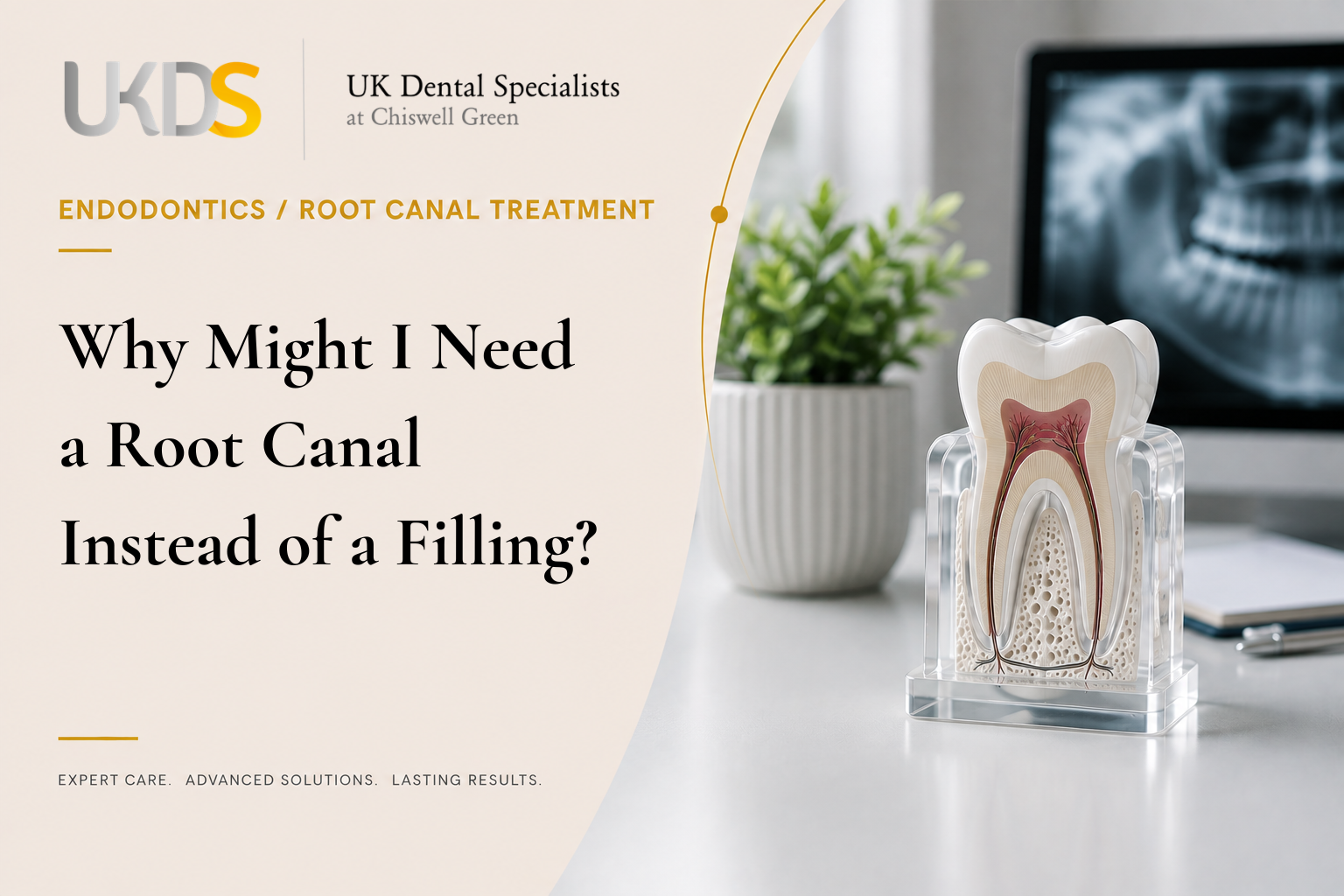
If you have tooth decay, you might reasonably expect your dentist to remove the damaged area and place a filling. In many cases, that is exactly what is needed.
But sometimes the problem has travelled deeper into the tooth. If the soft tissue inside the tooth — known as the pulp — has become severely damaged or infected, repairing the outside of the tooth with a filling will not treat the problem inside it.
This is when root canal treatment may be recommended.
The difference comes down to how deeply the tooth has been affected and whether the pulp inside it can remain healthy.
What Is the Difference Between a Filling and Root Canal Treatment?
A filling repairs part of the tooth that has been damaged, most commonly by tooth decay.
Your dentist removes the decayed tooth tissue and restores the resulting cavity with a filling material. NHS guidance explains that a filling is commonly needed when decay has caused a hole in the tooth.
Root canal treatment deals with a different problem.
Inside every tooth is the pulp, which contains nerves and blood vessels. This tissue extends into narrow spaces within the roots called root canals.
If bacteria reach the pulp and cause significant inflammation, damage or infection, treatment needs to address the inside of the tooth rather than simply repairing the outer structure.
Root canal treatment removes the infected or damaged pulp, cleans and disinfects the root canal system, and then fills and seals it. The aim is to remove infection and preserve the natural tooth where possible.
Why Can’t the Dentist Just Place a Filling?
A filling can close a cavity, but it cannot remove infection that has already developed within the pulp and root canal system.
Imagine the tooth as having several layers.
The hard enamel forms the outside. Beneath it is dentine, and deeper still is the pulp.
When decay is limited to the harder outer parts of the tooth, removing the decay and placing a filling may be sufficient.
However, if decay progresses far enough to reach the pulp, bacteria can enter the centre of the tooth. At that stage, simply sealing a filling over the tooth does not remove the bacteria and damaged tissue inside the root canals.
NHS guidance specifically notes that when tooth decay reaches the pulp in the middle of the tooth, root canal treatment may be required.
How Does Tooth Decay Reach the Pulp?
Tooth decay usually develops gradually.
Bacteria in dental plaque produce acids that damage the tooth surface. If the decay is not treated, it can progress through the enamel and into the dentine underneath.
As the decay becomes deeper, the distance between the bacteria and the pulp becomes smaller.
Eventually, the pulp can become inflamed or infected.
At this point, you may experience symptoms such as:
- Persistent toothache.
- Sensitivity to hot or cold that lingers.
- Pain when biting or chewing.
- Swelling around the tooth.
- A gum boil or dental abscess.
- Darkening of the affected tooth.
However, symptoms alone cannot tell you whether you need a filling or root canal treatment. Some teeth with significant pulp damage cause relatively little pain, while toothache and sensitivity can have several other causes.
An examination is therefore needed to establish what is actually happening.
Is Deep Decay the Only Reason You Might Need Root Canal Treatment?
No. Tooth decay is one of the most common reasons, but the pulp can also become damaged in other ways.
Leeds Teaching Hospitals lists several possible reasons for root canal treatment, including extensive decay, deep or leaking restorations, repeated replacement of fillings, dental injuries and cracked teeth.
For example, a tooth may look relatively intact from the outside following an accident but still have suffered damage to the pulp.
Similarly, a crack can allow bacteria to reach areas inside the tooth that cannot simply be repaired by placing a filling over the surface.
This is why the decision is based on the condition of the whole tooth rather than simply the size of the visible cavity.
How Does the Dentist Decide Whether I Need a Filling or Root Canal Treatment?
There is no single symptom that automatically means root canal treatment is necessary.
Your dentist or endodontist will usually consider several pieces of information together.
They may ask:
- Where the pain is coming from.
- Whether hot or cold triggers it.
- How long any sensitivity lasts.
- Whether the tooth hurts when you bite.
- Whether the tooth has previously been filled or crowned.
- Whether there has been an injury to the tooth.
The tooth and surrounding tissues are then examined, and appropriate clinical tests and dental X-rays may be used to help establish what is happening.
At UK Dental Specialists in St Albans, the endodontic treatment pathway includes assessment and a pre-operative radiograph before root canal treatment begins. The practice’s wider consultation process is also designed around examining the patient, explaining the diagnosis and discussing the available treatment options before a treatment plan is agreed.
The aim is not to perform root canal treatment simply because a tooth hurts. It is to establish whether disease or damage within the pulp makes root canal treatment necessary.
Does Needing a Root Canal Mean the Tooth Is Badly Damaged?
It means the problem involves the pulp or root canal system, but it does not necessarily mean the tooth needs to be removed.
In fact, the purpose of root canal treatment is usually the opposite: to try to retain the natural tooth.
The British Endodontic Society explains that when the pulp becomes infected, the infected tissue needs to be removed and the inside of the tooth cleaned, disinfected and filled.
Without appropriate treatment, infection within a tooth can progress into the tissues surrounding the root. NHS guidance notes that an infected tooth may ultimately need to be removed if root canal treatment is not carried out.
Whether an individual tooth can be successfully saved depends on factors such as how much healthy tooth structure remains, whether there are cracks or fractures and the condition of the supporting tissues.
What Actually Happens During Root Canal Treatment?
Root canal treatment is usually carried out under local anaesthetic.
An opening is made in the tooth so that the dentist or endodontist can reach the pulp and root canals. The damaged or infected tissue is removed before the canals are carefully cleaned, shaped and disinfected.
The root canals are then filled and sealed to reduce the risk of bacteria entering them again.
UK Dental Specialists describes using a rubber dam during treatment. This is a thin sheet placed around the tooth to isolate it from the rest of the mouth. The practice also describes the use of precision instruments and disinfecting solutions to clean the root canal system before it is filled and sealed.
After root canal treatment, the tooth also needs an appropriate permanent restoration. Depending on the condition of the tooth, this might be a filling or, in some circumstances, a crown.
This final restoration is different from using a filling as the original treatment. The infection inside the tooth has first been addressed with root canal treatment; the restoration then repairs and protects the tooth afterwards.
Can a Dentist Tell Whether a Filling Will Be Enough Before Treatment?
Often, yes — but not every case is completely straightforward.
Clinical examination and X-rays can provide important information about the depth of decay and the condition of the tooth. Your symptoms can also help indicate how the pulp may be responding.
In some situations, however, the full extent of the damage only becomes clear once old restorations or decay are removed.
This is one reason dentists cannot always promise in advance that a very deeply decayed tooth will only require a filling.
If there is a significant risk that the pulp has been affected, your dentist should explain this as part of the treatment discussion.
When Might You Be Referred to an Endodontist?
Many general dentists carry out root canal treatment.
An endodontist is a dentist with specialist training in diagnosing and treating conditions affecting the pulp and tissues around the roots of teeth.
More complex cases may be referred for specialist assessment. This can include teeth with difficult root canal anatomy, previously treated teeth that have developed further problems, or cases where diagnosis is more challenging.
UK Dental Specialists has registered specialists in endodontics within its multidisciplinary team in St Albans. Its endodontic service treats root canal cases and retreatment, with equipment including operating microscopes and digital imaging used where appropriate.
So, Do I Need a Filling or a Root Canal?
The answer depends on where the problem is within the tooth.
A filling is often suitable when decay or damage can be removed and repaired without needing to treat the pulp.
Root canal treatment may be needed when the pulp has become irreversibly damaged or infected and simply restoring the cavity would leave the underlying problem untreated.
The important thing is not to judge the treatment you need from the size of the visible hole or the amount of pain you are experiencing. A proper diagnosis is needed.
If you have been told that you may need root canal treatment and would like to understand why a filling is not suitable, ask your dentist to explain what they have found and which part of the tooth is affected.
At UK Dental Specialists, patients can also be assessed by a specialist endodontist where appropriate, with the findings and available treatment options explained before treatment is planned.
FAQs
Can a Deep Filling Prevent the Need for Root Canal Treatment?
Sometimes decay can be treated with a filling before the pulp becomes significantly damaged. Whether this is possible depends on the depth of the decay and the condition of the pulp. Once the pulp is infected, simply placing a filling does not remove the infection from inside the root canal system.
Why Does My Tooth Still Hurt After Having a Filling?
A recently filled tooth can sometimes be temporarily sensitive, particularly after a deep filling. Persistent, worsening or spontaneous pain should be assessed because there are several possible causes, including problems involving the pulp. Pain alone does not confirm that root canal treatment is required.
Can I Have a Filling After Root Canal Treatment?
Yes. Once root canal treatment has cleaned and sealed the root canal system, the tooth needs a permanent restoration. Depending on the amount of tooth remaining and its condition, this may involve a filling or a crown.
What Happens If I Need a Root Canal but Only Have a Filling?
If infection remains inside the root canal system, placing a filling over the tooth does not remove it. The infection can persist or progress and may eventually affect the tissues around the root. The appropriate treatment depends on the individual tooth, so a clinical assessment is essential.