
 01727 800372

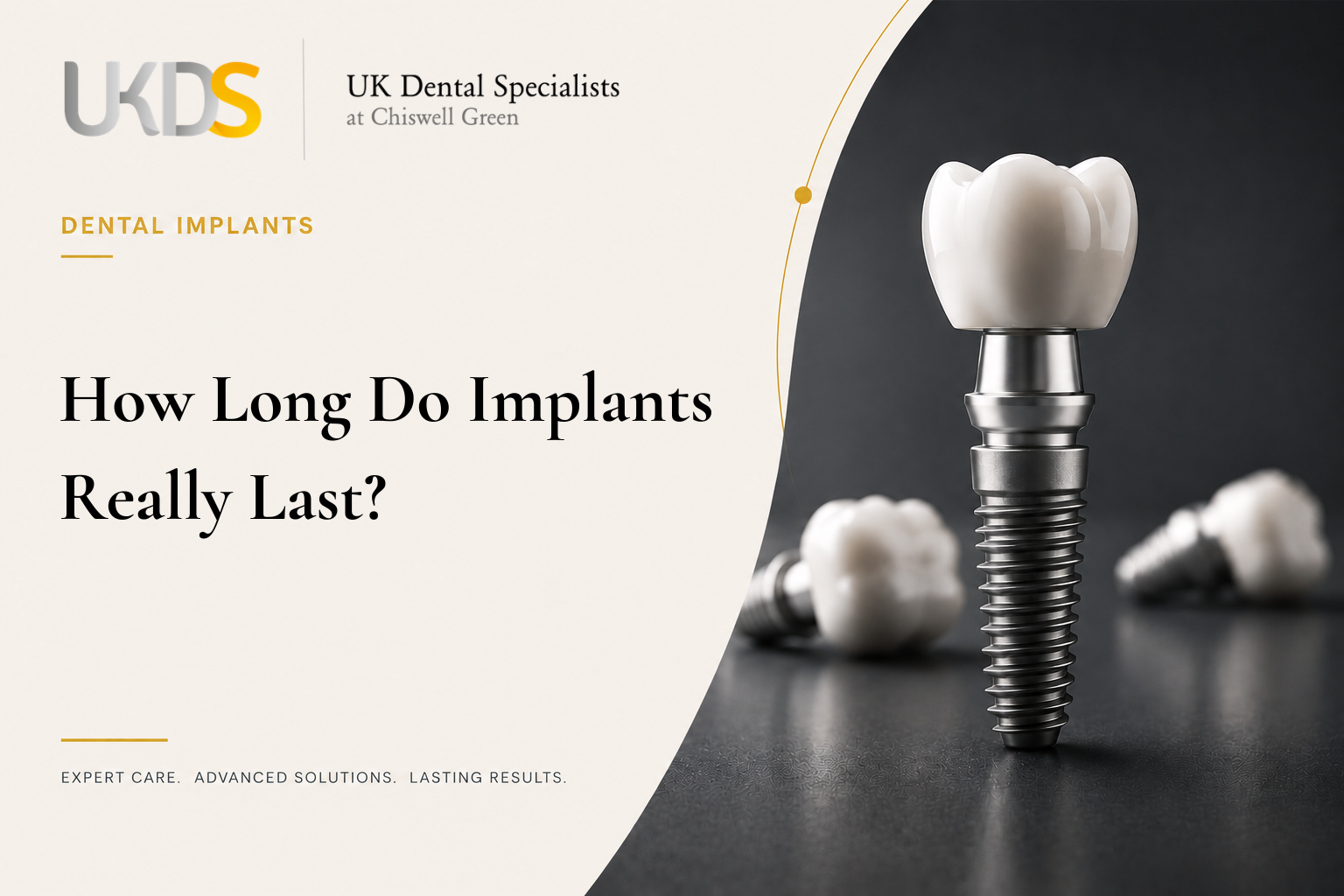
Dental implants are designed to be a long-term way of replacing missing teeth, but there is no single number that tells us exactly how long an implant will last.
UK patient information from Leeds Teaching Hospitals states that around 90% of dental implants placed 10 years previously are still present and functioning. The Association of Dental Implantology (ADI) cites research showing a 10-year survival rate of approximately 95% for implants supporting individual crowns.
Those figures are reassuring, but they should not be interpreted as a guarantee. How long an individual implant lasts depends on your oral health, general health, smoking status, how well the implant was planned and restored, and — importantly — how it is looked after afterwards.
Some implants remain functional for considerably longer than ten years.
The Implant and the Replacement Tooth Are Not the Same Thing
When patients ask how long a dental implant lasts, it helps to understand that an implant-supported tooth has several parts.
The dental implant is usually a titanium component placed within the jawbone. It effectively replaces the root of the missing tooth. Above this sits a restoration, such as a crown, bridge or denture, which replaces the visible part of the missing tooth or teeth.
These different components do not necessarily have the same lifespan.
The implant itself may remain stable for many years while the crown, bridge, screws or other components attached to it become worn or require maintenance. Cambridge University Hospitals advises patients that implant-supported crowns, bridges and dentures can wear with time and may eventually need refurbishment or replacement.
This is an important distinction. Needing a new crown on an implant does not automatically mean that the implant itself has failed.
What Affects How Long a Dental Implant Lasts?
There is rarely one single factor responsible for the long-term performance of an implant. Several aspects of your health and dental care work together.
Gum Health and Daily Cleaning
Healthy gums and supporting bone are particularly important around dental implants.
Although an implant cannot develop tooth decay, plaque bacteria can still collect around it. This may initially cause inflammation of the gum around the implant. If the inflammation progresses and bone begins to be lost, the condition is known as peri-implantitis.
Left untreated, progressive bone loss can eventually compromise the support around an implant. Poor oral hygiene and a previous history of gum disease are recognised risk factors for implant complications.
That is why an implant should not be regarded as a tooth that can simply be fitted and forgotten.
Smoking
Smoking can affect healing and is associated with an increased risk of implant complications and failure. Guy’s and St Thomas’ NHS Foundation Trust advises patients considering implants to stop smoking and remain a non-smoker where possible to reduce the risk of complications.
Smoking does not automatically mean someone cannot have dental implants, but it is an important factor to discuss during assessment.
Your General Health
Certain health conditions can also influence implant treatment.
For example, uncontrolled diabetes is recognised as a factor that can increase implant-related risks. Changes in health and medication over the years may therefore matter even when an implant has been functioning successfully for a long time.
Your dentist should be kept informed about significant changes in your medical history.
Your Bite and How Much Force the Implant Receives
Dental implants have to cope with the forces generated when we bite and chew.
Some people clench or grind their teeth, a habit known as bruxism. Excessive or poorly distributed forces can contribute to wear or mechanical complications involving the implant restoration and its components. Implant planning therefore involves more than simply placing an implant into available bone; the way the replacement tooth will function within the bite also matters.
The Original Treatment Planning
Long-term implant treatment involves both biological and restorative considerations.
There needs to be healthy supporting gum and bone, but the crown or bridge also has to be designed so that it functions well and can be kept clean.
At UK Dental Specialists in St Albans, implant treatment is planned collaboratively between specialist clinicians working in periodontics and prosthodontics. This means the surgical aspects, gum and bone health, function and final restoration can be considered together rather than in isolation.
This multidisciplinary approach is particularly relevant when thinking about an implant not simply as a procedure, but as something that needs to function and remain maintainable for many years.
Can a Dental Implant Last for Life?
It is possible for a dental implant to remain functional for a very long time, but nobody can reliably promise that an implant will last for life.
Research gives us useful survival figures across groups of patients, but it cannot tell us exactly what will happen to one particular implant over several decades.
The Royal College of Surgeons of England notes that implant outcomes are influenced by factors including dental health and hygiene, gum disease, smoking, diabetes, bruxism and the maintenance programme following treatment.
A better way to think about dental implants is therefore as long-term treatment that requires long-term care, rather than as maintenance-free treatment with a guaranteed expiry date — or no expiry date at all.
What Can You Do to Help Your Dental Implants Last?
There is a significant part of implant maintenance that happens after the treatment has been completed.
To give an implant the best opportunity to remain healthy, you should:
- Clean thoroughly around the implant every day, including the areas your dentist or hygienist has shown you how to access.
- Attend regular dental examinations and hygiene appointments at the interval recommended for you.
- Avoid smoking where possible, particularly because of its effect on gum health and healing.
- Tell your dental team about changes to your health or medication.
- Seek advice if something changes, rather than waiting for your next routine appointment.
Regular professional maintenance allows the tissues around an implant to be monitored and problems to be identified earlier. The ADI describes ongoing maintenance as an important part of reducing biological and mechanical complications over the long term.
The appropriate recall interval varies between patients, so somebody with a history of gum disease or other risk factors may require closer monitoring than somebody at lower risk.
What Are the Warning Signs of a Problem Around an Implant?
Problems around implants do not always cause significant pain in their early stages.
It is worth arranging an assessment if you notice persistent bleeding around an implant when brushing or cleaning, swelling of the surrounding gum, an unpleasant taste, or any movement involving the implant-supported tooth or restoration. These can be warning signs of inflammation or another problem that deserves investigation.
Early assessment matters because some problems can be much easier to manage before significant damage has occurred.
Long-Term Maintenance Matters Just as Much as the Implant Itself
Dental implants have strong long-term survival figures, and many continue to function well beyond ten years. But the implant, the surrounding tissues and the replacement tooth all need ongoing care.
Good cleaning, healthy gums, sensible management of risk factors and regular professional reviews all contribute to longevity.
At UK Dental Specialists, implant care brings together expertise in gum health, implant surgery and restorative dentistry. The practice’s implant team includes specialist periodontists and specialist prosthodontists who work collaboratively when planning and managing implant treatment.
If you are considering a dental implant and would like to understand its likely long-term outlook in your particular circumstances, an individual assessment can look at your gum health, available bone, bite, medical history and the type of replacement tooth required.
There is no way to promise exactly how many years an implant will last. What good treatment planning and maintenance can do is give it the best opportunity to remain healthy and functional for as long as possible.
FAQs
How Many Years Do Dental Implants Usually Last?
There is no fixed lifespan. UK patient guidance reports that around 90% of implants are still present and functioning after ten years, while other research reports 10-year survival figures of approximately 95% for implants supporting single crowns. Individual outcomes vary.
Do Dental Implant Crowns Need Replacing?
They can. The implant within the jaw and the crown attached to it are separate components. Crowns, bridges and other implant restorations can wear, chip or require maintenance over time even when the underlying implant remains healthy.
Can Dental Implants Get Gum Disease?
Inflammation can develop in the tissues around an implant. If this progresses and causes supporting bone loss, it is known as peri-implantitis. Good plaque control and regular monitoring are important for reducing this risk.
How Often Should Dental Implants Be Checked?
There is no single interval suitable for everybody. Your recall schedule should reflect your individual risk factors and oral health. Regular professional monitoring and hygiene care form an important part of long-term implant maintenance.