
 01727 800372


If you’re considering dental implants to replace one or more missing teeth, you may be wondering what happens at your first appointment. Will you need scans? Will the dentist be able to tell you whether implants are suitable? And will you have to make any decisions straight away?
A dental implant consultation is an opportunity to understand your options before committing to treatment. Your dentist will examine your mouth, assess your oral health and discuss what you would like to achieve. They may also recommend scans to help determine whether implants are appropriate.
At UK Dental Specialists in St Albans, the initial consultation is designed to give you a clear understanding of your dental health, the available treatment options and what may be involved in replacing your missing teeth.
What Is a Dental Implant Consultation?
A dental implant consultation is the first stage of planning treatment to replace missing teeth with dental implants.
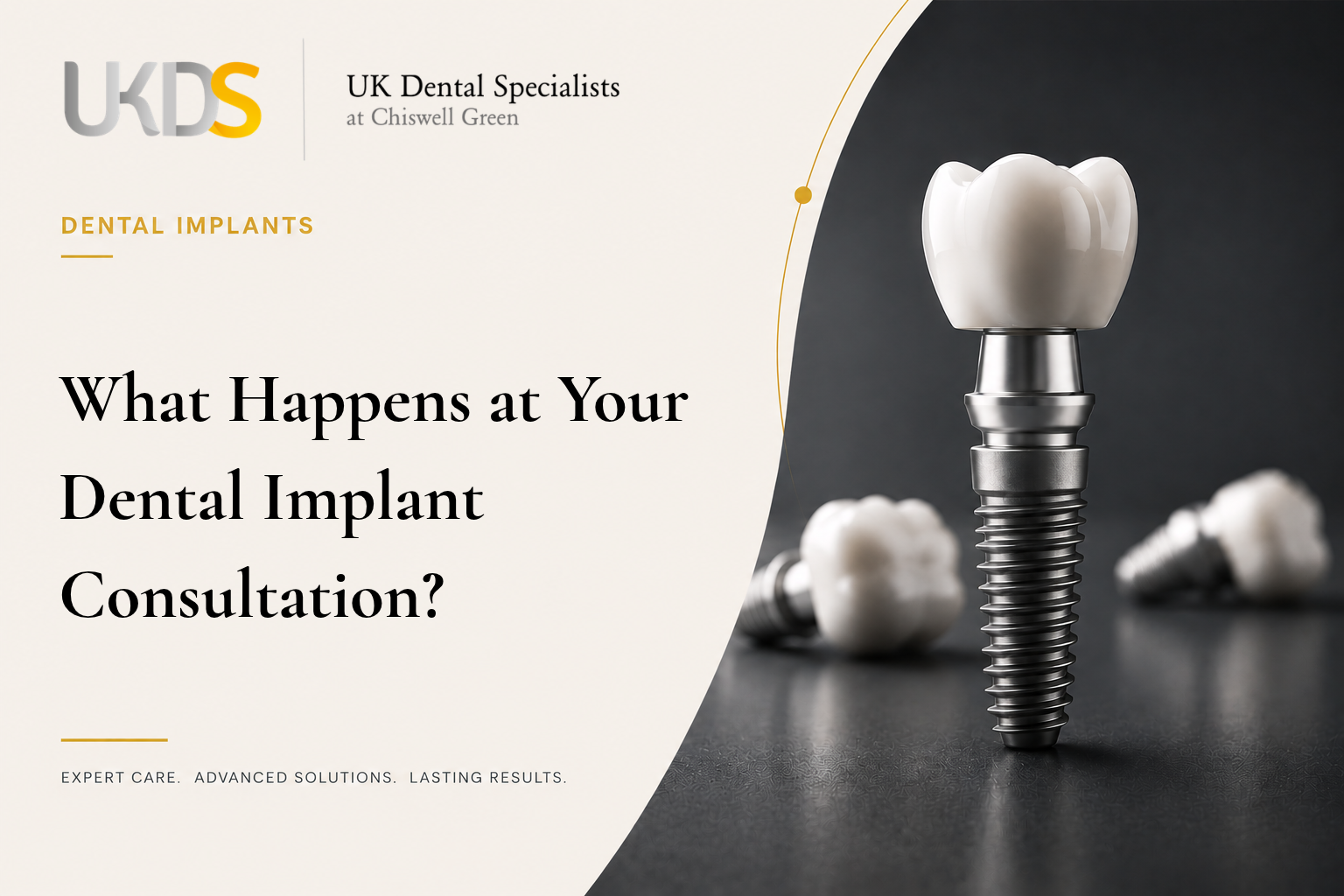
A dental implant is a small titanium post that is placed into the jawbone to act as an artificial tooth root. Once it has integrated with the surrounding bone, it can support a replacement tooth, bridge or, in some cases, a denture.
However, not everyone requires the same treatment. The number of missing teeth, the condition of your gums and the amount of available jawbone can all influence the recommended approach.
The consultation allows your dentist to assess these factors and explain which options are likely to be suitable for you.
Importantly, the appointment is about gathering information and answering your questions. You do not need to decide whether to proceed with treatment on the day.
What Happens During Your First Dental Implant Consultation?
Although every patient’s circumstances are different, a dental implant consultation will usually involve several important stages.
1. Discussing Your Dental Concerns and Medical History
Your dentist will begin by asking about your dental health and what has brought you to the appointment.
Perhaps you have recently lost a tooth, have been living with a gap for several years or are finding your existing denture uncomfortable.
You will have an opportunity to explain what concerns you and what you hope treatment might achieve.
Your dentist will also review your medical and dental history. This is important because certain health conditions, medications and lifestyle factors can influence healing and implant treatment.
For example, they may ask about:
- Previous dental treatment and any history of tooth loss.
- Medical conditions, including diabetes.
- Medications that may affect bone health or healing.
- Smoking or other tobacco use.
- Previous problems with your gums.
These questions help your dentist understand your individual circumstances and identify anything that may require further investigation.
2. Examining Your Teeth and Gums
The next stage is a clinical examination of your mouth.
Successful implant treatment depends on having a healthy environment to support the implant, so your dentist will assess more than just the space left by a missing tooth.
They will examine your remaining teeth, gums and bite, looking for any problems that could affect treatment.
Particular attention is given to gum health. Gum disease can damage the tissues and bone that support your teeth, and uncontrolled gum disease may increase the risk of complications around dental implants.
If there are signs of gum disease, your dentist may recommend treating this before implant placement.
Your dentist will also consider how your upper and lower teeth meet when you bite. This helps with planning a replacement tooth that functions comfortably alongside your natural teeth.
3. Taking X-rays or a 3D Scan
One of the most important parts of implant planning is assessing the jawbone.
Unlike a removable denture, a dental implant is anchored within the bone. There must therefore be enough suitable bone to support it safely.
Dental X-rays can provide useful information about your teeth and surrounding structures. In some cases, a more detailed three-dimensional scan may be needed.
This is known as a cone beam CT scan (CBCT).
A CBCT scan provides a detailed 3D view of the jaw, helping your dentist assess:
- The height and width of the available bone.
- The proposed position of the implant.
- The location of important structures, including nerves and sinuses.
- Whether additional procedures, such as bone grafting, may be necessary.
UK Dental Specialists has an on-site CBCT scanner, allowing detailed three-dimensional imaging to support implant assessment and planning when clinically appropriate.
Not every patient will require the same imaging, and some investigations may be arranged as a separate stage of the assessment.
4. Discussing Your Dental Implant Options
Once your dentist has assessed your oral health and reviewed the available information, they can explain which treatment options may be appropriate.
The recommendations will depend on factors such as the number of teeth missing, the condition of your jawbone and the health of your remaining teeth.
For example, a single missing tooth may be replaced with an implant-supported crown, while several missing teeth may require an implant-supported bridge or another type of restoration.
Your dentist should also explain any relevant alternatives, such as conventional bridges or dentures.
This discussion is particularly important because dental implants are not necessarily the best option for everyone.
The aim is to help you understand the advantages, limitations and practical considerations of each approach so you can make an informed decision.
What If You Don’t Have Enough Bone for Dental Implants?
Some patients worry that they will be told they cannot have dental implants because they have been missing teeth for a long time.
When a tooth is lost, the jawbone in that area gradually changes because it is no longer supporting a natural tooth root. Over time, this can reduce the amount of bone available for implant placement.
However, reduced bone levels do not automatically mean implants are impossible.
Depending on your circumstances, a procedure called bone grafting may help create additional bone support. This involves placing grafting material in an area where more bone is required.
Some patients may need additional treatment before implant placement, while others may have alternative options that avoid grafting.
Your dentist can explain what is possible once the relevant clinical examination and imaging have been completed.
How Is Your Personalised Treatment Plan Created?
After the assessment, your dentist will use the findings to develop a treatment plan tailored to your needs.
This may explain the recommended type of implant restoration, whether any preparatory treatment is needed and the anticipated stages of treatment.
Dental implant treatment generally involves:
- Completing any necessary dental or gum treatment.
- Placing the implant into the jawbone.
- Allowing time for the implant to integrate with the bone.
- Fitting the final replacement tooth or restoration.
- Attending follow-up appointments and maintaining good oral hygiene.
The exact sequence varies. Some patients require additional procedures or longer healing periods, while others may have a more straightforward treatment pathway.
At UK Dental Specialists, implant treatment benefits from a multidisciplinary approach involving clinicians with expertise in gum health, implant placement and restorative dentistry.
This means the health of the supporting tissues and the design of the replacement teeth can be considered together during treatment planning.
Following your consultation, the practice provides a written report explaining the findings and proposed treatment plan. This gives you an opportunity to review the recommendations in your own time.
Will You Have Dental Implant Surgery at Your First Appointment?
No. A standard dental implant consultation is an assessment and planning appointment, rather than the implant placement procedure itself.
Your dentist must first establish whether treatment is suitable and identify any factors that could affect the proposed surgery.
In some cases, further imaging, treatment for gum disease or additional planning appointments may be needed before implant placement can be arranged.
There is no need to feel pressured into making an immediate decision.
How Should You Prepare for Your Dental Implant Consultation?
You do not usually need to make extensive preparations before attending an initial consultation.
However, it can be helpful to bring a list of your current medications and details of any relevant medical conditions.
If you have previous dental X-rays, treatment records or a referral letter from your regular dentist, these may also be useful.
It’s worth thinking about any questions you would like answered.
For example:
- Am I suitable for dental implants?
- Are my gums and jawbone healthy enough?
- Will I need additional treatment before an implant can be placed?
- What alternatives should I consider?
- How long might the complete treatment process take?
- How will I need to look after my implant in the long term?
There is no such thing as an unimportant question when considering dental treatment. Understanding what is involved can help you feel more comfortable with your decision.
Taking the First Step Towards Replacing Missing Teeth
A dental implant consultation is about understanding your oral health and exploring the options available to you.
By examining your teeth and gums, assessing your jawbone and discussing your individual needs, your dentist can help you decide whether implants are an appropriate way to replace your missing teeth.
At UK Dental Specialists in St Albans, patients can benefit from specialist-led assessment, detailed treatment planning and input from different dental disciplines where needed.
If you’re considering dental implants, arranging an initial consultation can help you understand your options and make an informed decision about the next steps.
Frequently Asked Questions About Dental Implant Consultations
How Long Does a Dental Implant Consultation Usually Take?
The length of a dental implant consultation depends on your individual circumstances and the assessments required. Appointments may take longer if you have several missing teeth, complex dental needs or require additional imaging. Your dental team can advise you how much time to allow when arranging your consultation.
Is a Dental Implant Consultation Painful?
A dental implant consultation is generally comfortable because it mainly involves discussing your dental health, examining your mouth and assessing your teeth and gums. X-rays and 3D scans are also non-invasive. If you have any particularly sensitive or painful areas, let your dentist know before the examination.
Can I Have a Dental Implant Consultation If I Still Have a Damaged Tooth?
Yes. You don’t necessarily need to have a damaged tooth removed before attending a dental implant consultation. Your dentist can assess whether the tooth can be saved or whether extraction and replacement may be appropriate. If removal is necessary, they can also discuss how this might affect the timing of implant treatment.
Am I Too Old for Dental Implants?
There is no fixed upper age limit for dental implant treatment. Suitability depends more on your general health, oral health and the condition of your jawbone than your age alone. Many older adults can be suitable candidates, although an individual assessment is needed to determine whether implants are appropriate.
Can I Get Dental Implants If I Have Gum Disease?
Having gum disease doesn’t automatically rule out dental implants, but it does need careful assessment. Active gum disease can affect the tissues supporting both natural teeth and implants, increasing the risk of complications. Your dentist may recommend treating and stabilising your gum disease before considering implant placement.